Fields covered
Physics of life (POL) represents a broad community of scientists that address questions inspired by the study of living systems using the tools of physics: a quantitative approach using physical techniques and/or mathematical modelling. The field of physics of life covers processes from the level of molecules to tissues, organs, organisms, up to ecological systems. In the past decade, the research efforts of the Dutch biophysics community have mainly focused on life at the smaller scales, from molecules to cells. Currently, experimental and computational methods move towards larger, more complex and multicellular systems, while maintaining the rigor of fundamental, quantitative analysis.
Big question
How can we relate structures, interactions and dynamics in living systems to biological functionality at different length- and timescales?
Methods and instrumentation
Key methods of the field are statistical physics and information theory, dynamical systems, coarse graining, advanced microscopy and spectroscopy, single-molecule analysis, nano/microscale manipulation, structural modelling and network theory, quantitative cellular and molecular readout technologies and medical physics. Importantly, there is a need for continuous feedback between computational modeling and experimental molecular/cellular research. The field is multi-disciplinary, with tight connections to disciplines such as biology, chemistry, computer science, mathematics, medicine, (bio-)informatics, material science and nanoscience.
Connection to other NWO disciplines and domains
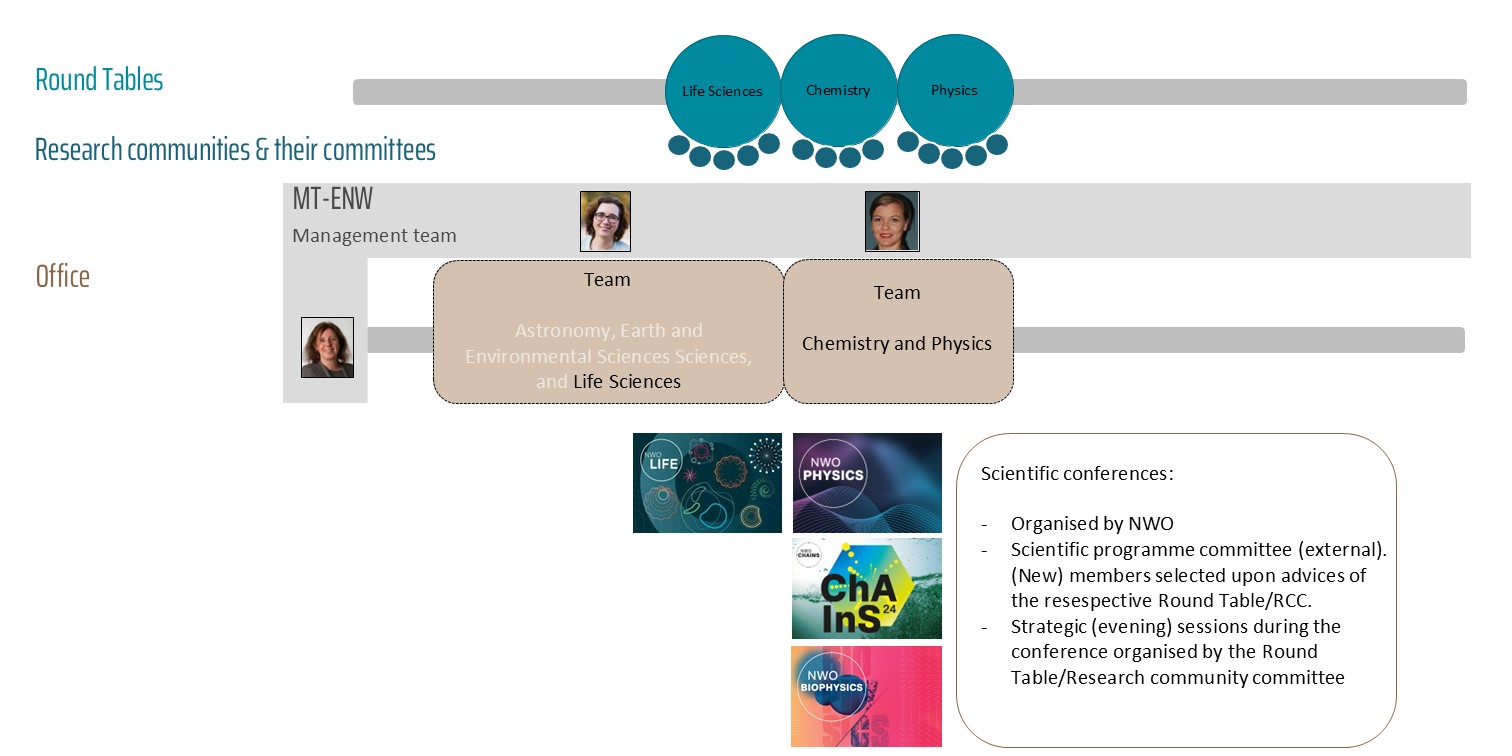
Within physics there are many connections: the research community committee fluids and soft matter (FSM) is interested in bioinspired, active materials, and/or soft materials, which relates to one of our focus areas. The physics of soft-condensed matter shows a large overlap with the physics of living matter. The micro- and nanofabrication activities that are strongly pushed in the research community committee nano, quantum and material physics (NQMP) are also of interest to our community. The research community committee physics of technology and instrumentation (PTI) spans a broader scope, but their instrumentation development efforts also connect to POL. In the NWO Science domain, we have lively interactions with the life sciences discipline, illustrated by 15 years of jointly organised DutchBiophysics meetings, nowadays NWO Biophysics is organised by the Science Domain. The research community committee Chemistry of Life (COL) is the natural chemistry counterpart of POL; members of our research community committee frequently participate in research community committees of chemistry. The increased interest in larger systems can strengthen our ties to earth sciences. POL is well positioned to serve fields across the Science Domain with advice and (joint) committee memberships. Across the domains, we recognise opportunities for closer interactions with the ZonMW and AES domains, in which research community committee can provide a more fundamental, physics-based perspective. The BBoL programme, the BaSyC Gravitation, and EVOLF Summit programme are good examples of multidisciplinary partnerships, often involving private partners, and exemplify the added value of POL: We provide a fundamental understanding of the molecular structures, dynamics and interactions at the heart of cellular functions, while promoting the social and economic implementation of this new knowledge.
Contribution to societal challenges, key enabling technologies and broad research themes
Many of the great challenges, as described in the NWA themes “Origin Of Life”, “The quantum / nano-revolution”, “Personalised Medicine” , “Energy Transition”, “Measuring And Detecting”, and “Materials”, have a clear POL component. Health challenges including cancer, aging, neurological disorders, and muscular diseases have a molecular origin and biophysical studies will provide novel insight into the origins of these processes. New materials are often inspired by how novel properties emerge from the organisation of molecules at lower levels in biology; some therapeutic approaches have very specific requirements, like for regenerative medicine and certain tissue/bone replacements. Moreover, the photosynthesis research in the POL community plays a fundamental role in the change to sustainable energy sources. These advances lead to new methods for biological research, new functional materials, advanced instrumentation for diagnosis, new (personalised) intervention schemes and the development of innovative therapeutic approaches.